On 10th November, I attended a seminar by Dr Sarah Zylinsky, as she discussed octopuses and their ability to avoid potential predators.
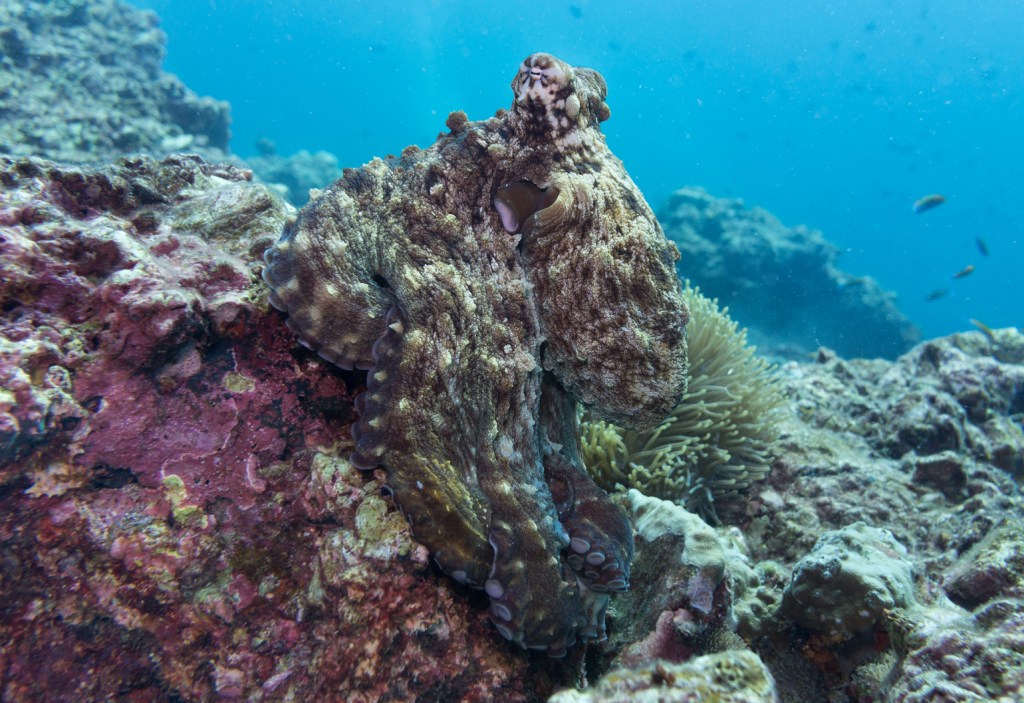
Octopuses are within the cephalopod phylum, a group of molluscs. Despite their large, complex brains and behaviour, they have a “live fast, die young” lifestyle, in which they are active predators.
Despite being a successful predator, octopuses also serve as a food item to many different species and as such, have evolved methods to avoid detection:
Dynamic Colouration: a rapid neural controlled colour change, which makes use of the three distinct layers of their skin, by creating new colours, or even by reflecting light back. The three layers are: formed off:
- Top layer: chromatophores – pigment sacks that expand and retract to change colour
- Mid layer: iridophores – no colour, reflect iridescent colours
- Bottom layer: leucophores – no colour, reflects environmental colour
A truly amazing fact to mention at this point, is that octopuses are colour-blind, meaning any colours that it may change to have been evolved via natural selection.
Crude Polymorphy: octopuses are able to change the shape and texture of their body, being able to shape their body to appear like rock or coral.
Ink: When it is detected the octopus can then release a ‘smoke screen’, of melanin ink and mucus, to blind the predator temporarily, so that it may escape and hide again.
Some octopus ink varies however, with the blue ring octopus’ ink containing neurotoxins, and vampire squid having luminescent ink (possibly to stun predators). It also tastes awful, so a predator going in for bite may get more than they bargained for.
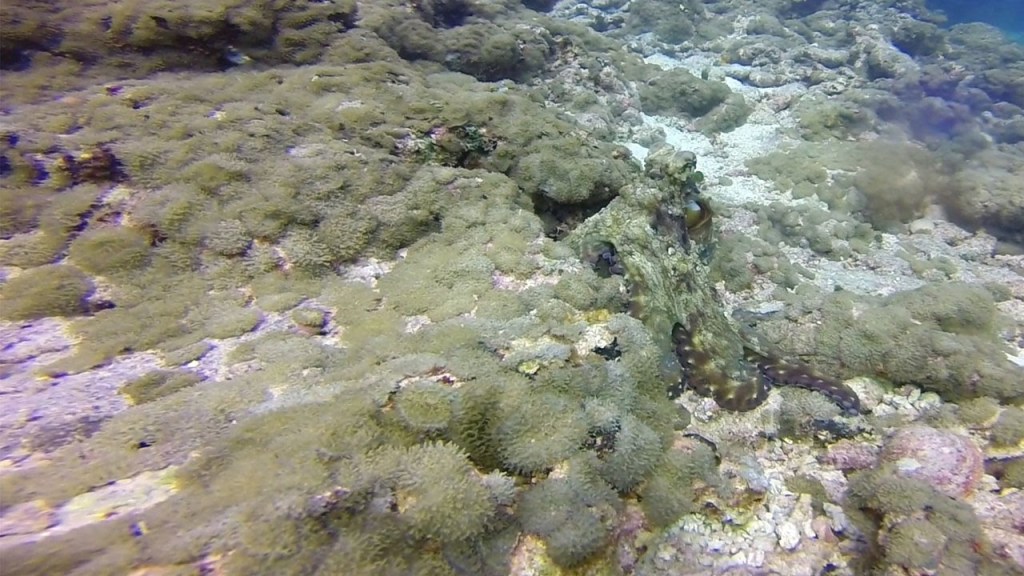
Deeper in the ocean, other methods become more common. These are:
Transparency: In the upper mesophalagic (around 200-500 metres down) sea level, some octopuses develop transparency so that predators below, or above them find them difficult to detect, as all they will see is light or darkness respectively.
Light Absorption: Some deep-sea predators use biological searchlights to detect prey, so rather than reflecting light back (showing that there is a prey item), some octopuses absorb the light so as to remain undetected.

For me, cephalopods hold a strange and alien fascination.
They are very far removed from we vertebrates and yet, cephalopods are so incredibly advanced, physiologically and behaviourally.
Sarah Zylinsky, gave the example of how vertebrates and cephalopods have very convergent eye structures, differing in only one small (yet important) way, in that the nerves of the retina exit the back of the cells as opposed to the front, meaning they have no blind spot.
This seminar covered the physiological aspects of the octopus, however I myself would be much more interested in learning the behavioural or even cognitive features they hold, and it may even be a subject to study myself.
Unfortunately many of her papers are not open access, and can’t be found on JSTOR. But she does have several on cuttlefish (a close relative of octopus) that I will link in. [1], [2], [3], [4]. If you have access to scientific papers, via university or work, I would strongly recommend looking up her work.
Lukas Edwards, 19th February 2020
 Biology Express: Zoology