The One Blog to End them All

It’s been a long journey at Bangor University and it is now coming to an end, with final module assessments and dissertation drafts being handed in soon. This year I have been forced to consider what comes next.
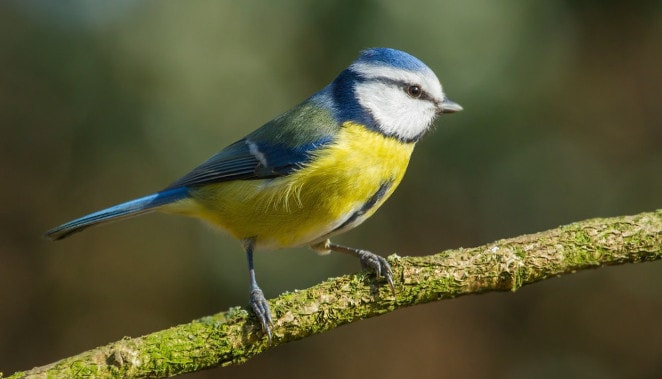
A blue tit (Cyanistes caeruleus), perching on a branch. gardenbird.co.uk

The lectures and seminars I have attended during this year have been of great help, and my only regret is not attending them throughout my entire time at Bangor. But none the less here are the influences that they have had:

Conservation is very appealing.

Paul Cross‘ lecture on collapsing bee populations, along with Stuart Marsden‘s lecture on exploitation and Kevin Anderson‘s talk on Global Warming, have all demonstrated that we as humans have a great tendancy to destroy our habitat and environment as a side effect of our supposed ‘advancement’.

Advancement in agriculture, fishing, pharmaceuticals and industry, should never be at the cost of our planet, biodiversity and animal welfare. Working in research and management would be extremely fulfilling, qnd would allow me to play a role in assisting in the recovery and conservation of our planets fauna.
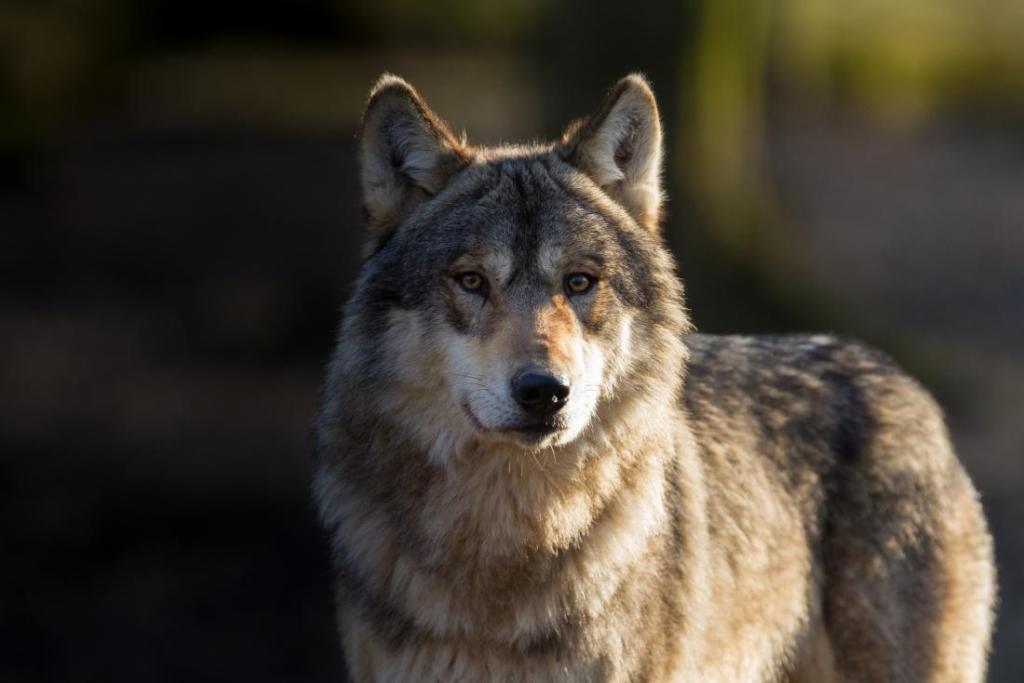
A grey wolf (Canis lupus) the species I originally came to university to study. britannica.com

Some lectures have also shown my particular love of behaviour

Richard Holland‘s talk on bat navigation, as well as Jorn Cheney‘s lecture on bird flight and Sarah Zylinsky‘s lecture on Octopus camouflage, are all incredibly important to me as well as they are directly looking at behaviour and bio-mechanics. My favourite areas of study in biology.

They have demonstrated the importance, and genuine fascination, of knowledge regarding behavioural and physiological function and mechanisms; as it allows for a deeper insight into the animals themselves and also into technology we can develop from those principles.

Despite all the amazing talks and seminars, one of them clearly stood out to me

It was all brought together by Chris Jones, in the Cornwall Beaver Project. In which he takes an animal we have reasonably good information on, and tests to see how it can benefit our local environments and towns.

But even our knowledge of beavers couldn’t have predicted the rapid benefits from their introduction into the test site: creating wetlands, increasing biodiversity and creating additional streams to reduce the water level downstream. This is the hands on application of knowledge that is ideal for me.

An osprey (Pandion haliaetus) hunting trout in Scotland. bbc.co.uk

Conservation is possibly one of the most needed fields in zoology, and is where academic knowledge is put into practice. That is why I now know I want to work in conservation.

To get to the work I want to do, I will need more experience:

  • Summer (June): begin volunteering, to gain work experience for future. As well as attending any additional sessions I can (such as bird ringing).
  • September: Begin Masters Degree in Ecology, hopefully continue volunteering to a small degree.
  • 1 Year: Complete masters, begin work placement and applying for work at conservation bodies.
  • 2 years: Obtain a permanent position at a conservation, or conservation research body.
  • If possible do a PhD, as it will open more doors into research work.

My goal for 2 years time is to have obtained a permanent position at a conservation or research body, and from here I will proceed to make a five year plan to further progress my career and contribution to conservation.

Lukas Edwards, 3rd March 2020

Cornwall Beaver Project

Chris Jones, a livestock farmer from Cornwall, witnessed massive flooding from 2012-2014 and came up with an ingenious way to prevent it…

Close up image of a European beaver. farminguk.com

He first suggested the idea in 2014 to an EA geomorphologist (someone who studies geographic morphology) who was suggesting the idea of building a damn that neither had the money to build or maintain. What could be a cheap method be that required no maintenance be?

Beavers. Wiped out in the UK in the 1500’s, they are well documented to slow down water flow and prevent flooding downstream, by holding the water in the land upstream.

For a full-scale reintroduction he said: “we needed a license, and the conditions on which they are given is pretty much impossible”, as it required all the neighbouring landowners to agree.

“I’ve never known two Cornish farmers to agree on anything”

He joked to the lecture. But this meant instead of an introduction scheme, he instead had to have a fenced off area to hold them in as a testing area. And this would require more money than he had to introduce this ‘gateway mammal’: “easily available, doesn’t cause you much harm, but leads you to better things”.

So he set forth to make partners for the endeavor:

  • Woodland Valley Farm
  • Cornwall Wildlife Trust
  • Exeter University (hydrology)
  • Coast Project
  • Southampton University (fish surveying)
  • Derek Gow Consultancy (provides beavers)
A European beaver constructing a dam. Dams generally consist of tree branches, twigs and vegetation. oppla.eu

With financial, skill, resource and labour support from the various partners they set to work, beginning by being the first site worldwide to have accurate hydrology and environmental records from before the introduction.

After recordings were done, a “beaver-proof fence” was put up around the perimeter of the reserve to ensure they didn’t escape, to stay on the happy side of nearby land owners as well as for their own protection.

They were released on 16th June 2017

Both a male and female were released (from Devon and Wales respectively), and the first damn was found only 2 days later, which increased in size day by day, until there was near a foot of water height between the two sides.

Progression of the first dam, over five days. Chris Jones

In the time between the reintroduction and when the lecture was given there had already been many changes across the 32 weeks:

  • 4 Dams
  • Lodge building commenced
  • original pond tripled in volume
  • 2 more ponds created, aswell as a wetland
  • 2 stream channels instead of one (doesn’t fully block stream, so some water flows through whilst the rest forms a new stream)
  • Increase in abundance and biodiversity
  • The female is hopefully pregnant

Over such a short period this is a massive amount of progress, and I am eager to hear of any further developments. But he set out his future hopes as: creating more sites where reintroduction can occur, the beaver being recognised as a native species, maintain a breeding population and further increase in biodiversity.

Beavers are mammals that spend much of their time in and around fresh water, particularly ponds and rivers which they are well known to dam. images-naturally.co.uk

The work is truly phenominal

Re-introductions of species is difficult and highly rewarding work, with other examples being beavers in Bavaria, and grey wolves in Yellowstone National Park. The skill and effort are amazing, but still dwarfed by the colossal effects they can have. The Cornwall Beaver Project is a truly amazing feat.

Conservation has always been an interest, but I much prefer the idea of working hands on, on site with animals, and I think reintroduction projects may provide that experience and career that I am really after, and I will keep an eye out for any similar projects that may be taking place in future, as an ideal career choice.

Direct Exploitation of Wildlife

Stuart Marsden gave a lecture some time ago, discussing over-exploitation in it’s different forms, and how human’s are causing massive damage to nature, sometimes without even realising it. [1], [2], [3], [4], [5].

Black rhinoceros (Diceros bicornis). wwf.org

He began by showing a slide of photographs, representing the various forms of exploitation we have: fishing, hunting, trophy hunting, science, pet trade (wild animals) and culling; all of these conjure different images but in essence they all mean taking animals from the wild through captivity or death.

Many of these forms of exploitation are considered necessary, whilst others are ingrained in cultural practices within different countries; such as in Indonesia where a man is sometimes only considered complete if he has: ‘a wife, house, knife, horse and bird’.

Stuart went on to question the room on what is ‘right and wrong’, when showing the different forms of exploitation. Ask yourself, what is worse?

  • Is it worse to make bears dance, or test pharmaceuticals on them?
  • Accidentally catch hundreds of dolphins, or purposefully catch hundreds of thousands of fish (many of which don’t get eaten)?
  • Wear fur, or have hats made of rare bird’s feathers?
  • Trophy hunt, or farm many times more meat than we could ever need?
One of the last dancing bears in Napal. worldanimalprotection.org

“A lot of conservation organisations struggle with ethics.”

This statement stunned me… How can this be something that conservationists struggle with? Isn’t it their job to be ethical?

Unfortunately there are some conservation bodies that compromise in order to fund their efforts, such as by allowing controlled trophy hunting, or in one case by catching and illegally selling parakeet in order to fund their reserve.

Even the IUCN (Internation Union for Conservation of Nature), aim for sustauinable exploitation, rather than ending unnecessary exploitation altogether, and this is the opinon of many conservation bodies.

As frustrating as it is they’re not wrong, it would be too difficult and cause too much uproar if all exploitation was limited/ stopped. With too much resistance no real good can be done.

But exploitation is growing all the time… Can we afford to take a middle ground on this topic?

The songbird crisis in Indonesia. theecologist.org

This lecture really shocked me

Although exploitation has always been an obvious feature in the world, it is often unimaginable at how low it goes at times. It makes me realise that conservation doesn’t just save the environment and nature, it is also about freeing animals from pain and harm.

As I have said in several other blogs, I would be deeply honoured if I had the opportunity to help stop any of these exploitative behaviours and conserve nature, and I would be more than happy to pursue this as a career path.

Lukas Edwards, 19th February 2020

How to Hide: Octopus Edition

On 10th November, I attended a seminar by Dr Sarah Zylinsky, as she discussed octopuses and their ability to avoid potential predators.

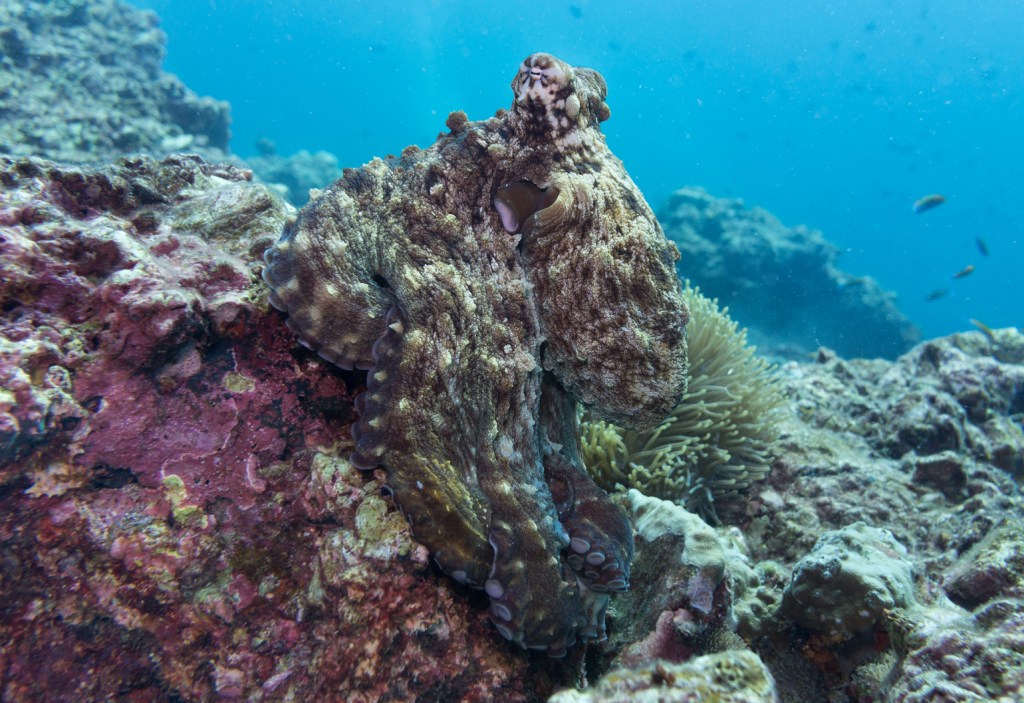
A hiding octopus (one of the easier to see ones). createdigital.org

Octopuses are within the cephalopod phylum, a group of molluscs. Despite their large, complex brains and behaviour, they have a “live fast, die young” lifestyle, in which they are active predators.

Despite being a successful predator, octopuses also serve as a food item to many different species and as such, have evolved methods to avoid detection:

Dynamic Colouration: a rapid neural controlled colour change, which makes use of the three distinct layers of their skin, by creating new colours, or even by reflecting light back. The three layers are: formed off:

  • Top layer: chromatophores – pigment sacks that expand and retract to change colour
  • Mid layer: iridophores – no colour, reflect iridescent colours
  • Bottom layer: leucophores – no colour, reflects environmental colour

A truly amazing fact to mention at this point, is that octopuses are colour-blind, meaning any colours that it may change to have been evolved via natural selection.

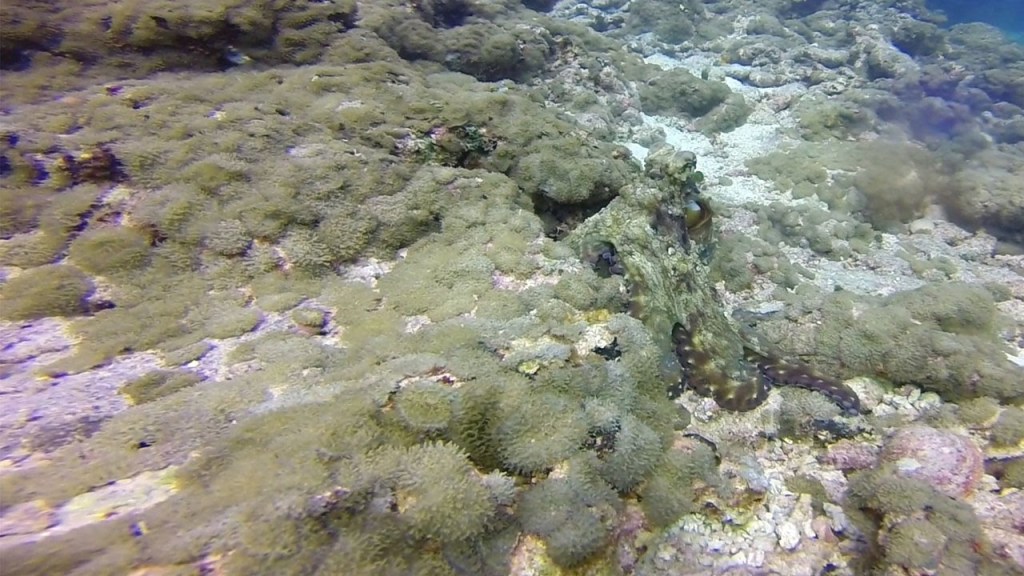
Crude Polymorphy: octopuses are able to change the shape and texture of their body, being able to shape their body to appear like rock or coral.

Ink: When it is detected the octopus can then release a ‘smoke screen’, of melanin ink and mucus, to blind the predator temporarily, so that it may escape and hide again.

Some octopus ink varies however, with the blue ring octopus’ ink containing neurotoxins, and vampire squid having luminescent ink (possibly to stun predators). It also tastes awful, so a predator going in for bite may get more than they bargained for.

Screenshot from a video of a camouflaged octopus. youtube.com

Deeper in the ocean, other methods become more common. These are:

Transparency:    In the upper mesophalagic (around 200-500 metres down) sea level, some octopuses develop transparency so that predators below, or above them find them difficult to detect, as all they will see is light or darkness respectively.

Light Absorption: Some deep-sea predators use biological searchlights to detect prey, so rather than reflecting light back (showing that there is a prey item), some octopuses absorb the light so as to remain undetected.

A hidden octopus that featured in several newspapers. telegraph.co.uk

For me, cephalopods hold a strange and alien fascination.

They are very far removed from we vertebrates and yet, cephalopods are so incredibly advanced, physiologically and behaviourally.

Sarah Zylinsky, gave the example of how vertebrates and cephalopods have very convergent eye structures, differing in only one small (yet important) way, in that the nerves of the retina exit the back of the cells as opposed to the front, meaning they have no blind spot.

This seminar covered the physiological aspects of the octopus, however I myself would be much more interested in learning the behavioural or even cognitive features they hold, and it may even be a subject to study myself.

Unfortunately many of her papers are not open access, and can’t be found on JSTOR. But she does have several on cuttlefish (a close relative of octopus) that I will link in. [1], [2], [3], [4]. If you have access to scientific papers, via university or work, I would strongly recommend looking up her work.

Lukas Edwards, 19th February 2020

Monitoring Biodiversity in Modified Tropics

Marion Pfeifer, gave a seminar discussing her work on how to monitor, and why this work is strangely novel.

Tobacco farm in Zambia – qz.com

She began by explaining how most studies only study forests rather than the modified areas, which leaves a large gap in our understanding of tropical ecosystem dynamics.

As such, Marion is has been planning a project looking into biodiversity in human modified-tropical landscapes, but this leads to a bigger question.

How do we monitor landscape biodiversity?

Standard methods for monitoring biodiversity are as follows:

  • Species List – a list of all species in the area
  • Index of Abundance – a number of individuals of a species found per unit of effort (eg. 11 good dogs per km).
  • Estimating Population Size – using data to predict the size of the entire population.

An index of abundance is best in Marion’s situation, as they are ideal for comparing species counts across different areas, and are much less expensive than population estimates.

So now we know how to do the study, we need to understand what the hypotheses are, that are being studied.

Human Activity Reduces Natural Biodiversity

This is a well established fact and Marion’s hypotheses seek to expand on this, which is why there are over half a dozen hypotheses!

Out of the two hypothesis there is a key one: Crop yield increases when close to natural habitats (when there is an increased biodiversity).

Although this study hsn’t been carried out yet, it holds a lot of potential to be a pivotal piece of research for both agriculture and conservation.

This work will assist in conservation efforts as it may help to encourage a greater biodiversity on and around plantations and small farms, which will help promote potentially endangered species.

Two different examples of food crops, one with high biodiversity and the other with low. – foodnavigator.com

Conservation has always been a passion for me

From being young I was drilled in recycling, never to litter and to be as sustainable as possible, and Marion has well demonstrated how a single research project can have so much potential.

In future I would love to work in conservation, as it is very fulfilling to know that the work you do, goes towards creating a better and more sustainable world.

Lukas Edwards, 18th February 2020

Birds Teaching Us To Fly

On 22nd November, Jorn Cheney gave a seminar on the morphing of bird wings, and how this may influence the design of future aircraft.

A goshawk in flight. –flickr.com

Cheney, began by reflecting on the current methods of flight, which use ‘brute force’ to account for the forces acting on the plane, rather than accounting for via complex mechanics, like birds do.

For example the F13 plane, which produces so much force that unless in flight, its engine must be cooled to prevent it from overheating.

This brute force mechanism, could be exchanged or subsidised with a more mechanically sound solution, inspired by the wing morphing of a bird.

Wing morphing, is when a bird changes the shape of its wing (angle, shape, inclination etc.) so as to be optimal to the conditions it is under, such as updrafts, gusts and crosswinds.

This is a very profitable method

It was calculated that an American personnel carrier, if its drag was reduced by only 1%, would save an approximate $140 million/ year in fuel. Now imagine if this was increased to 5%? $700 million/year. 10%? $1.4 billion/ year. 20%…

Airbus A400M. wikipedia.org

As such, Cheney studies how this can be done, with a main focus being on how the shape of the body and wings, affects the air currents surrounding the body in flight.

Using recordings of their test birds, they created a model predicting the movement of air currents, but this then needed to be tested.

He did this by creating tiny soap bubbles, using a mix of helium and standard air, so that they float steadily in the air, and recording birds flying through them.

Barn owl, flying through a wall of air/ helium bubbles. Note the air beneath it being pushed down and the air at the wingtips appearing as a vortex. rvc..ac.uk

It was really quite beautiful

Seeing the movement of the air, as the bird flew through the bubble cloud was amazing, and perfectly imaged the flow of air around the bird.

This was incredible, not only in the visualisation of the currents, but also in that it showed his model to be correct. Now to apply it to planes.

Using this information, he then moved on to discuss the function of a tail, which was really quite elusive, with the closest estimate they can make being that it assists in stability, by providing negative lift.

“Hitting that sweet spot can be hard”

He said, which is why flying in gusts and windy conditions is so hard. In order to account for the massively offsetting winds that would destroy a conventional plane, birds simply angle their wings in order to reject the wind.

This is largely thanks to their having a shoulder, which begs the question could this benefit an aeroplane? The answer is (theoretically) yes, if planes had a hinged wing that can adjust itself based upon the wind, then it could likely save not only millions of dollars in fuel, but also save the discomfort of flight turbulence.

I found this seminar fascinating

Not only working hands on with animals, but also in studying the biomechanics of flight and the forces involved, and although I do believe there is years of research yet to be done, to make this truly applicable to everyday plane flight, it is definitely very good and very interesting work, that I would happily be involved in, should I progress down the field of ornithology.

[1]

Lukas Edwards, 14th February 2020

Global Warming: Hope from Despair

On Wednesday 20th November, I attended a long awaited lecture by the world renowned Kevin Anderson; he has done incredible work alongside the Swedish and British governments, along with working alongside the EU to tackle the crisis of climate change.

World map of raising temperatures. – Accuweather

                He began his lecture by reminding us of the Paris Agreement; an agreement in which many European States, and several African countries, all agreed to cap global warming at 1.5oC-2oC by limiting the amount of CO2.

                However the UK (and indeed many other) governments have not kept this. With many new gas and oil extraction sites being opened within the last year alone, such as Clair-Ridge Oil platform, Glengorm Gas Field and the Preston New Road Fracking Site, to name a few.

“We have fundamentally failed at climate change”

He stated regarding the issue, especially when considering the misinformation being provided, claiming the UK has had a 42% reduction since 1990, when in actual fact this figure doesn’t include aviation or shipping.

We have in fact only seen a 10% fall since 1990, and other “climate progressive countries”, he quoted, have had no decrease, with Norway’s emissions increasing by 50%, and Ireland being up 25%.

There is a large amount of offsetting, and speculative future technologies that are being relied on, and are not getting the job done.

CO2 is one of the largest contributors to climate change, and we must make reforms to our industry and infrastructure to reduce it as much as possible. activesustainability.com

“It is Technocratic Fraud”

With offsetting (which he called: “paying someone to diet for you”), partial accounting, speculative Negative Emission Technologies (NETs) we are consistently and purposefully failing at solving climate change.

The real way to achieve change is via carbon budgeting, rather than by implementing deadlines. The planet will suffer more if we do it by the end of the deadline, than if we implement change immediately.

According to the Paris Agreement, reductions in CO2 emissions should be partially based on equity, meaning the wealthier countries should be responsible for more reduction, but this has not been happening.

Relating this to carbon budgeting, proportionally the UK should be 3-3.8 billion tonnes of CO2 from 2020-2100. Sounds like a lot, right? Wrong.

We would fulfil our 80 years carbon budget, in under 9 years of current emissions.

Is there any Hope?

Until only few years ago, Anderson and others had little hope for the future of climate change, but some recent events have raised his hopes:

  • Social Media – grants a more diverse view of the world rather than that of the ‘media barons’
  • Political Change – The questioning of the establishment, and the radical breakthrough of new ideas.
  • Emergence of People Power – with everyday people, you and me, having the power to decide what we do and don’t want, which is only amplified in larger groups
  • Plummeting price of renewables – making them more accessible for all, and allows for a greener future.

He concludes by stating that real change needs to come from a renewable revolution. Discarding our current economic model, of constant expansion and exploitation of natural resources, and adopt a green new model, with sustainable energy and production of resources.

It is only by having a rapid economic transformation from an 81% fossil fuel dependant country, to a fully renewable country.

But what can YOU do?

Talk. As simple as this, you need to talk with friends, family and colleagues about how you can reduce your emissions, and collectively, you can make a massive difference, and you can help influence the millionaires and the policy makers who are pioneering our demise.

This has really inspired me, and given the message that as biologists, scientists and human beings we should strive to help heal the damage we have done. In my future career I think it would be very fulfilling to work in conservation of animals or in attempting to stop climate change, as these are two man made problems that we must all fight to prevent occurring.

He has given similar lectures all across the country, some of which can be found on Youtube.

Lukas Edwards, 14th February 2020

Orientation and Navigation in Bats

Dr Richard Holland, discussed the orientation and navigation in bats also mentioning why they are an ideal model animal for homing and mammal migration.

Group of bats, flying to a nearby source of food. futurism.com

Birds may have been thought to be an equivalent study species for bats, however they orient themselves by very different methods.

Birds use the inclination of the earth’s magnetic field as a compass and map by which to navigate, however Richard Holland’s research showed that homing bats instead use a ‘sunset calibrated magnetic compass.’

The homing bats used, showed that they calibrated their compass using the band of polarised light at sunset, which was tested by rotating the band by 90o (causing the bats to travel 90o in the wrong direction); migrating bats used the suns disk to calibrate their compass, which was tested by presenting the bats with a mirrored image of the sunset, causing them to travel 180o in the wrong direction.

However bats do not have innate migrating direction, as juveniles travel in many directions as opposed to a more focused direction of travel for multiple individuals.

The way they detect electromagnetic energy is undetermined

Bats use their compass by detecting the earth’s magnetic field, however the way in which they use it is still undetermined.

They appear to use a magnetic particle as their compass, which can be tested by exposing them to a magnetic pulse, disorienting their magnetic compass. They also become disoriented when their cornea is anaesthetised (a test done on mole rats, to similar affect).

Bat in flight. –sciencenews.org

This showed that the magnetic particle in use may exist somewhere in the eye, however it has not been definitely proved to exist there.

He concluded by drawing up that bats navigate using a sunset calibrated compass (using either the suns disk, or bands of polarised light), which is detected via a magnetic particle potentially existing within the eye.

It was fascinating

The methods used and effort put into the studies was fascinating, and it was encouraging to see the amount of hands-on studying being done.

This seminar has made me strongly contemplate looking into hands-on work with animals, such as radio-tagging; however more than everything I find in particular the Function and mechanism questions of great interest, and I believe it would be extremely fulfilling to help answer them, and will also be looking into ways in which I may go about asking and researching them. I also loved the opportunity to see how an individual’s physiology and mechanisms can change to better suite its behaviour, and am wanting to see more of this in the future, in my own research or others.

The research can be found online [1], [2].

Lukas Edwards, 14th February 2020

The Bee Collapse

I attended a seminar by Dr Paul Cross as he discussed the collapse of the bee populations, its cause, and why it may not be over.

– consumeraffairs.com

In 2006 near entire hives began disappearing overnight, with no sign of where they had gone, causing massive damage to the apiarists all over the world. This was called ‘Colony Collapse Disorder’ (CCD).

Many have worked to discover the cause of CCD, with the 3 main factors being: lice, nycema virus, and the true culprit, Pesticides; specifically the group Neonicitinoids (Neonics).

One of the worst qualities of neonics, is their ability to travel through the soil and be taken up by wild plants nearby to sites where they are used, as well as binding to the soil so that it’s half-life may exceed 1000 days.

During tests it was found that 1 gram of neonics (approx. the contents of a teabag) is enough to kill outright over 250 million bees. By 2002 20,000 tonnes of neonics were sold worldwide, enough to kill:

  • 5,000,000,000,000,000,000 bees (5 quintillion)
  • 142,000,000,000,000 bee hives (142 trillion)
  • 142,857 planets worth of bees… And we wonder why they’ve disappeared.
– theconservation.com

Direct Lethal Effects Of Neonics Are Not The Main Issue.

Despite the absurdly high kill rate of neonics, it is their ‘Sub-lethal’ affects that are the most damaging and the cause of CCD. These are affects that don’t kill the bee outright.

Using brand new technology, designed by Paul Cross and PhD students at Bangor University, they tracked bees, from 2 food sources (sugar water), one of which was infected with neonics.

They found that any bees who drank from the neonic infected food, became unable to navigate, and were unable to make their way back the hive; likely succumbing to starvation or exposure.

But with the new bee tracking technology becoming more advanced and effective every year, it shouldn’t be too long before we can determine the ultimate cause of death.

Now To End With Both Good And Bad News.

The good news is that neonics are now illegal. And given 5-6 years they will have broken down in the soil and have minimal to no effect. However a new pesticide, ‘Sufluxoflore’, is now entering the public domain, and it has already been shown to be just as toxic and harmful to bees and the ecosystem as Neonicitinoids.

We will undoubtedly now have years more of damage to our ecosystem, because of poor management of pesticides, and in my opinion this shows the dire need for change in governmental policy to help reduce and ban the use of non-specific pesticides.

The Harm we have done to our environment is astonishing.

With the use of pesticides, fertilizer run off, and greenhouse gases, I think this seminar showed the amount of damage we are doing without even realising we are doing it, and this lecture really inspired me to look into work in some kind of sector of conservation, be that managing conservation sites, or by working on research to bring an end to such damaging methods as unspecific pesticides.

This research (to my knowledge) has not been published but there are other spaces where you can read more about neonicitinoids and bees [1], [2], [3], [4]. But don’t forget to also try and attract bees to your garden, and maybe together we can help encourage the population to grow again [1], [2], [3], [4].

– a bee from my garden. He was tired and wouldn’t fly, so I mixed him a little honey-water.

Lukas Edwards, 13th February 2020

Design a site like this with WordPress.com
Get started